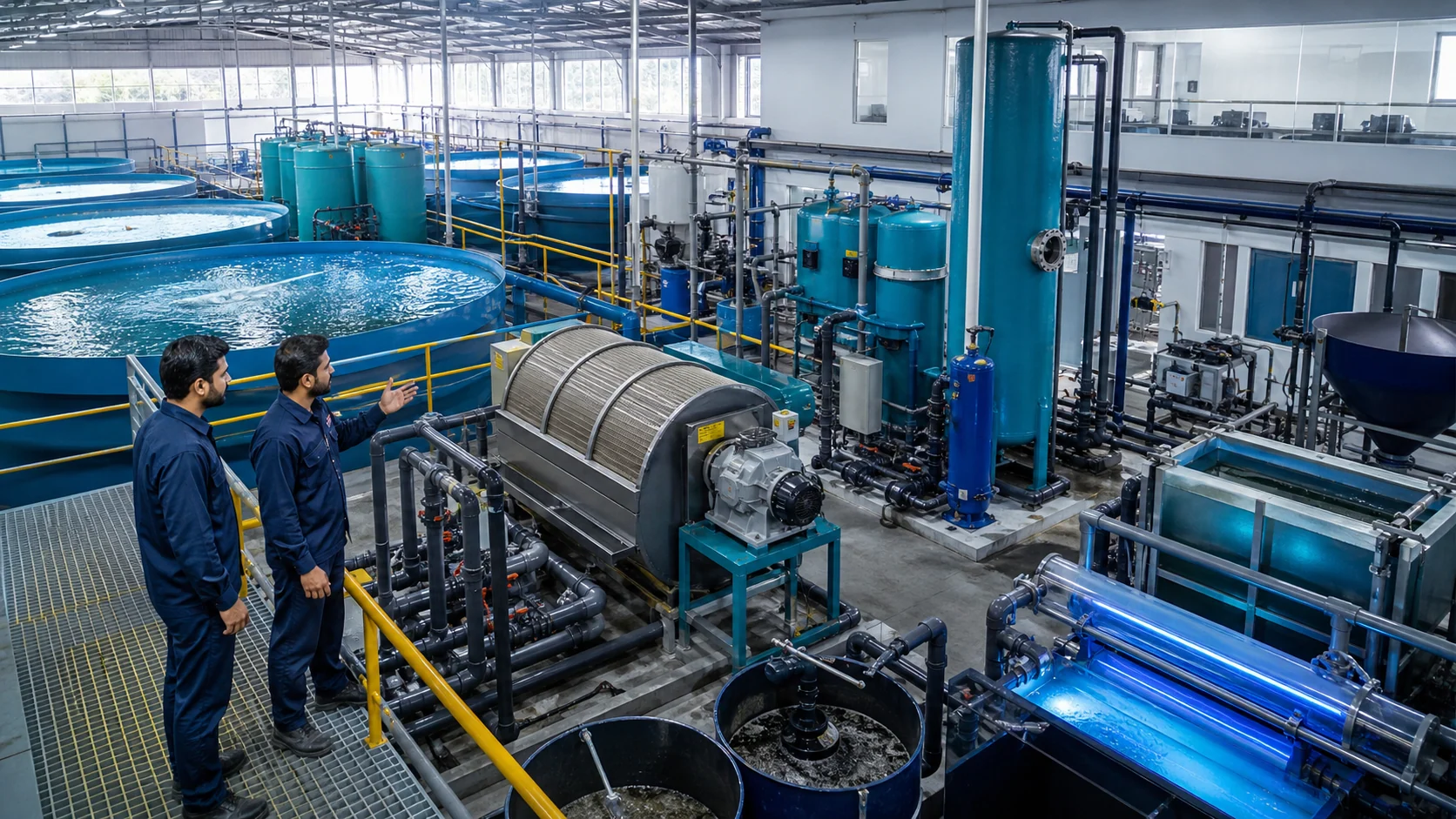
Integrated life-support systems developed around species, biomass, water quality and operating objectives.
Marine Blue designs RAS facilities that collect, treat and reuse process water while maintaining conditions suited to the cultured species and production plan. The design is approached as a continuous biological and hydraulic process, not as a group of unrelated tanks and filters.
Technical highlights
Production and source-water review
Process-flow and treatment-train development
Hydraulic, filtration, oxygen and gas-management design
Equipment definition and integration
Layout, access, drainage and workflow planning
Installation, commissioning and biofilter-start-up guidance
Training, SOPs and technical support within the agreed scope
Species, life stage, target biomass, feeding rate, temperature, salinity, source-water quality, production cycle, redundancy, energy availability, staffing, maintenance capability and future expansion influence the final configuration. These inputs determine tank arrangement, treatment capacity, flow distribution, equipment duty points and control philosophy.
02
Applications
Commercial finfish production
Indoor shrimp systems
Crab culture and holding
Hatchery and nursery systems
Broodstock, quarantine and live holding
Research and demonstration facilities
03
Operational value
A correctly planned RAS can reduce dependence on continuous water exchange, create greater control over culture conditions, improve the potential for biosecurity, capture waste in a structured way and support year-round production. Actual outcomes depend on design inputs, management and operating discipline.
Complete service information
A clear, complete view of the service
Explore the full technical scope, applications, advantages and project considerations.
Core Service 1 | Recirculating
Aquaculture Systems (RAS)
Integrated RAS process infrastructure for controlled aquatic production. Controlled water. Stable biology. Smarter production. Marine Blue designs RAS facilities that continuously treat and reuse process water while maintaining conditions suited to the cultured species and production plan. Each design is developed as an integrated life-support process—not a collection of disconnected components.
How Our RAS Approach Works
Solids are removed through appropriately selected mechanical filtration.
Dissolved wastes are managed through biological filtration and process control.
Oxygenation and aeration support biomass demand and system stability.
Degassing manages carbon dioxide and unwanted gases.
UV and ozone may be integrated where the treatment strategy requires them.
Sensors, controls, alarms, and operating procedures support consistent management.
Applications
Commercial fish production
Indoor shrimp systems
Crab culture and holding
Hatchery and nursery systems
Broodstock and quarantine
Live fish holding and research applications
Designed Around Your Project
Species, target biomass, feeding rate, temperature, source-water quality, production cycle, redundancy, energy availability, operator skill, and future expansion all influence the design. Marine Blue evaluates these variables before defining treatment capacity, tank layout, hydraulic flow, equipment configuration, and control philosophy.
Value of a Well-Designed RAS
Reduced dependence on continuous water exchange
Greater control over production conditions
Improved biosecurity potential
Year-round and location-flexible production
Structured waste capture and treatment
Scalable, data-informed farm management
Design a RAS around biology—not assumptions
Share your species, target harvest size, annual production goal, water source, and available site details to begin the engineering discussion.
Request a RAS Consultation | Submit Project Details
RAS Visual Engineering Concepts
Six ultra-realistic visual concepts illustrating how Marine Blue can present complete RAS infrastructure, facility planning, water treatment, indoor shrimp production, hatchery-to-grow-out integration, and operational resilience. Publishing note: These are conceptual engineering renderings, not photographs of completed Marine Blue projects and not final construction drawings. Project-specific dimensions, capacities, equipment selections, and piping must be verified through detailed engineering.
Complete RAS Process Hall
Ultra-realistic concept of culture tanks integrated with mechanical filtration, biological treatment, degassing, oxygenation, UV, heat control, pumps, and sludge management.
Commercial Multi-Tank RAS Facility
Elevated cutaway concept showing grow-out tanks, central treatment room, quarantine capacity, control space, headers, service aisles, and maintainable equipment zoning.
Operations concept combining plant supervision, duty/standby equipment, alarms, emergency oxygen, generator support, monitoring, and clear visibility across the production facility.
RAS project planning
RAS system design and turnkey project support in India
Marine Blue Aquaculture Solutions, based in Bengaluru, brings aquaculture engineering, treatment equipment and project execution together. Planning starts with the species, production target, site and source water, then connects the culture tanks, filtration, oxygen, utilities and operating workflow into one RAS design.
Operating visibility, alarms and equipment coordination.
RAS design and project questions
What is a recirculating aquaculture system (RAS)?
A RAS collects water from culture tanks, removes solids, treats dissolved wastes, manages oxygen and gases, and returns conditioned water to the animals. The treatment train and operating limits are designed around the species, life stage, feed load and production plan.
What determines the cost of a RAS project in India?
Project cost depends on production capacity, species, source water, tank layout, filtration and oxygen requirements, temperature control, power backup, building works, automation and the agreed installation scope. A site-specific feasibility and engineering review is needed before a meaningful quotation can be prepared.
Can a RAS be designed for fish, shrimp or mud crab?
The system can be planned for different production objectives, but it is not a universal equipment package. Finfish, indoor shrimp, mud crab, hatchery and nursery projects have different biological, hydraulic, handling and biosecurity requirements. Species suitability and local requirements must be reviewed for each project.
Which water-treatment equipment does a RAS need?
The design may include mechanical drum filtration, biological filtration, oxygenation or aeration, carbon-dioxide removal, pumping, monitoring and treatment barriers such as UV where appropriate. Protein skimming and ozone are considered only where water chemistry, production goals and safe operation justify them.
Does RAS eliminate water exchange or guarantee profitability?
No. Water reuse does not remove the need to manage make-up water, sludge, dissolved compounds and effluent. Production performance and commercial viability depend on engineering, stock quality, operating discipline, energy costs and market conditions. Neither a fixed water-reuse rate nor profitability can be promised for every project.
What should I share to request a RAS design consultation?
Share the project location, available site or building area, target species and production stage, proposed capacity, source-water information, power availability, budget range and expansion plans. These inputs help Marine Blue define the engineering scope, equipment requirements and commissioning pathway.