Skip to content
Automatic Mechanical Drum Filters

Products · Solids removal

Automatic Mechanical Drum Filters

Remove fine suspended solids continuously before they burden the process.

Automatic drum filters separate suspended particles from a flowing water stream through a rotating screened drum and automated cleaning cycle. They are commonly positioned early in a treatment train where rapid solids removal can reduce breakdown and downstream loading.

Product views

Equipment, installation and process

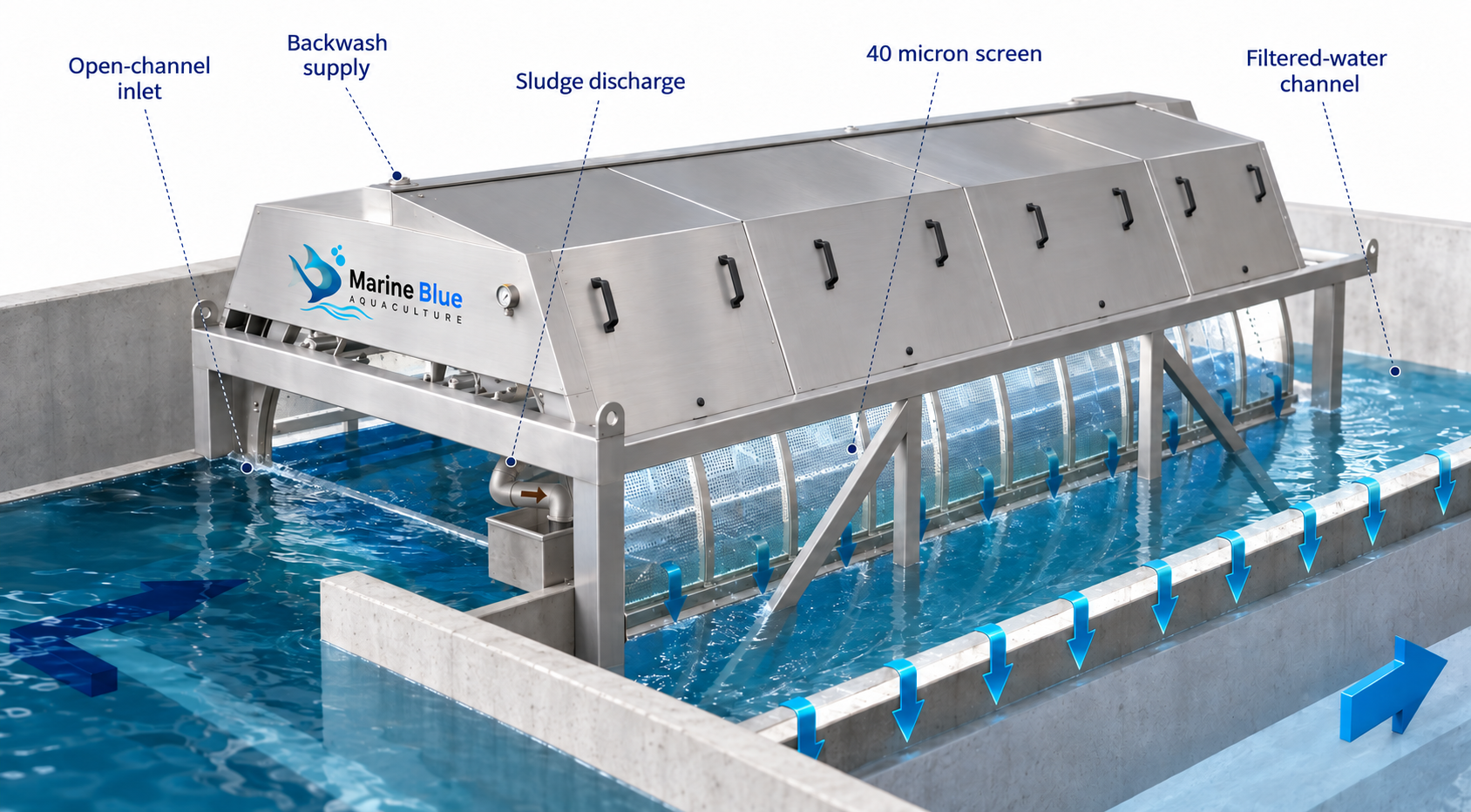
Marine Blue drum filter in an open-channel installation
VIEW 01

Open-channel arrangement

Illustrated open-channel arrangement. Final dimensions, connections and screen rating are defined for each project.

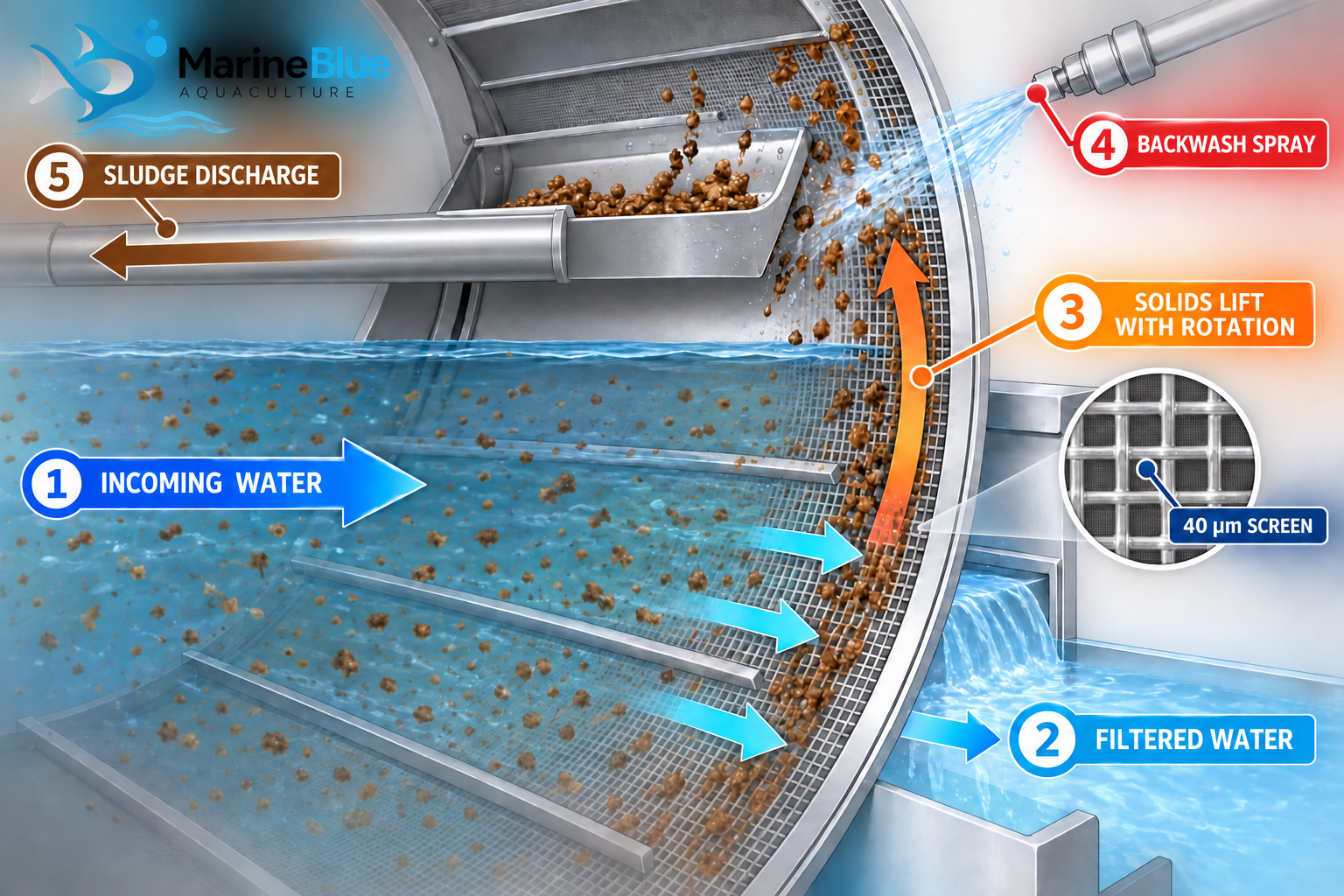
Drum-filter filtration cycle with incoming water, filtered water, backwash and sludge discharge
VIEW 02

Filtration process

Process illustration supplied by Marine Blue; the shown 40 µm screen is an example.

Selection and design considerations

01

Design flow and peak flow

02

Expected particle size and solids load

03

Screen opening

04

Allowable head loss and water level

05

Backwash-water supply and pressure

06

Materials and water chemistry

07

Waste collection and drainage

08

Bypass, redundancy and access

System at a glance

Primary role

Continuous solids removal

Design basis

Flow, particles & solids load

Interfaces

Backwash & waste drainage

Care

Screen, nozzles & sensors

Final capacities, materials, dimensions and operating limits are confirmed against the current model datasheet and project duty point.

01

Operating principle

Water passes through a selected screen opening while retained solids accumulate on the screen surface. A level or pressure signal initiates rotation and backwashing so the captured material is discharged to a waste channel while filtration continues according to the selected configuration.

02

Role in the system

The drum filter protects downstream biofilters, oxygenation equipment, disinfection processes and water clarity by controlling the solids load reaching them. It does not replace biological treatment or dissolved-organic management.

03

Applications

  • Recirculating aquaculture systems
  • Hatchery and nursery treatment
  • Indoor shrimp and fish facilities
  • Source-water or side-stream filtration
  • Other project-specific water-treatment duties

04

Integration requirements

The filter must be coordinated with upstream collection, gravity levels or pumping, waste drainage, electrical controls, backwash supply, bypass and downstream treatment. Hydraulic elevation can be as important as nominal flow capacity.

05

Operation and maintenance

Operating care includes screen inspection and cleaning, spray-nozzle checks, drive and bearing inspection, waste-channel cleaning, sensor verification and timely response to alarms. Maintenance access should be built into the layout.

06

Customer value

Early continuous solids capture can reduce manual cleaning, stabilize downstream loading and make sludge removal more deliberate. Actual separation depends on screen, particle characteristics, flow and operation.

Complete brochure information

Marine Blue Drum Filter

B01

Drum Filter

Patented design. Precision screening. Automatic cleaning.

  • Mechanical filtration
  • Engineered for excellence
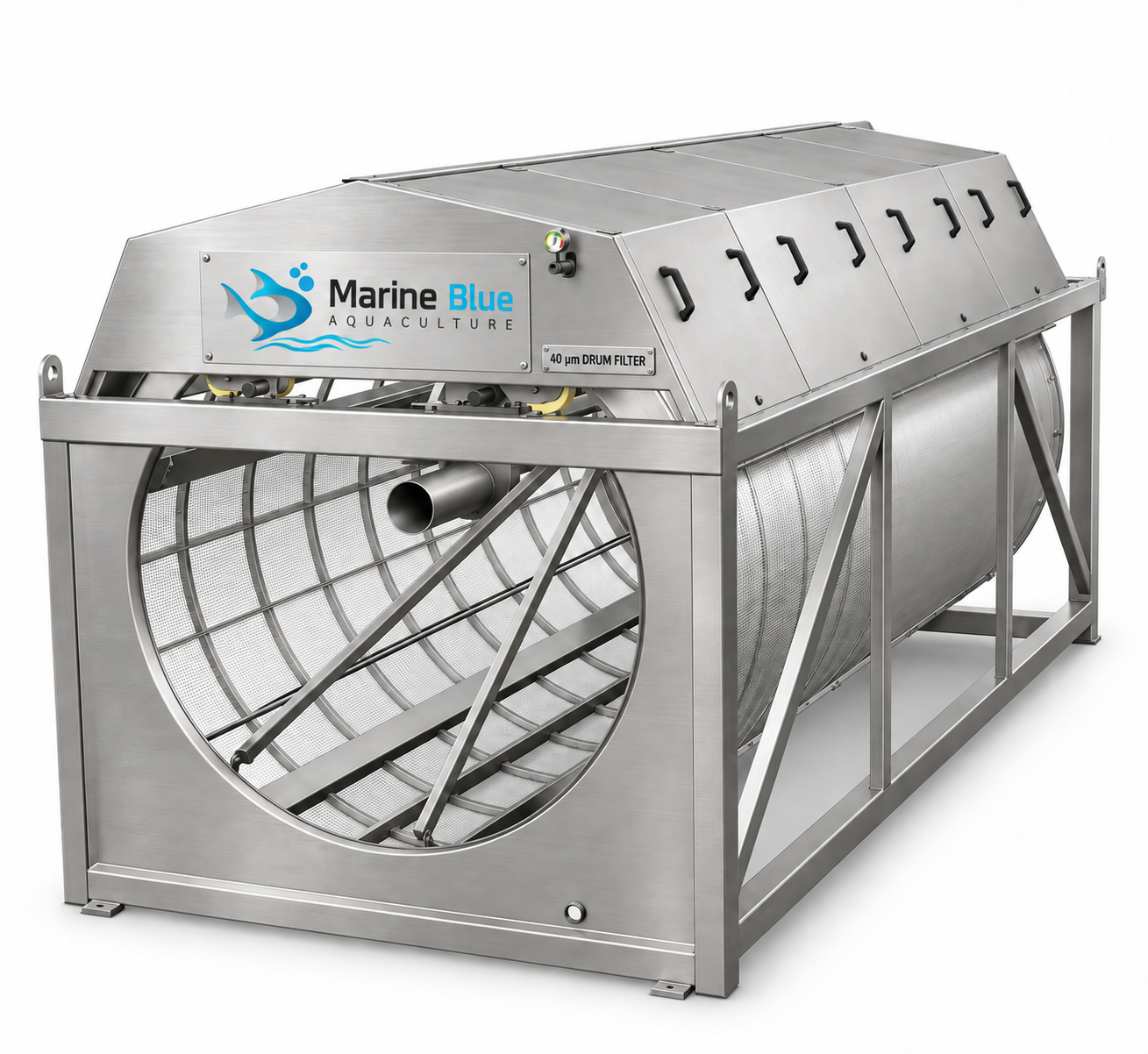
  • Supplied product visualisation. Illustrated configuration: 40 µm screen.
  • Patented design: Application-led engineering
  • NORD drive: German-made gearmotor
  • Custom screens: Sized to your process

B02

Reliable solids separation.

The Marine Blue Drum Filter combines our patented design, stainless-steel construction and a German-made NORD geared-motor unit to deliver controlled mechanical filtration for aquaculture and compatible water-treatment applications. A rotating microscreen separates suspended particles from flowing water, while the backwash system removes collected solids from the filtration surface.

  • Built around your water

B03

Engineered for excellence

Our drum filter is developed with reference to applicable ASME mechanical engineering requirements within the agreed design scope. Attention to structural support, drum alignment, drive selection and maintenance access supports dependable operation and long-term serviceability.

B04

Configured for the application

Every installation has a different balance of water flow, solids loading and required filtration quality. We customise the screen selection, effective filtration area, installation layout and operating configuration to suit the process, rather than assigning one flow rating to every screen size.

  • Illustrated open-channel arrangement. Final dimensions, connections and screen rating are defined for each project.

B05

The filtration process.

Process illustration supplied by Marine Blue; the shown 40 µm screen is an example.

The filtration cycle

  1. 01

    Water enters

    Incoming water carrying suspended solids enters the drum through the inlet arrangement.

  2. 02

    Water passes through the screen

    Water crosses the mesh into the filtered-water channel. Retained particles remain on the inner screen surface.

  3. 03

    Rotation lifts the solids

    The geared motor rotates the drum, lifting the loaded screen towards the wash zone.

  4. 04

    Backwash cleans the mesh

    External spray nozzles wash back through the screen, releasing retained particles into the internal collection trough.

  5. 05

    Sludge leaves the system

    Wash water and dislodged solids flow through the sludge outlet to the designated collection or treatment point.

  6. 06

    The cycle repeats

    Clean screen returns to the water. Rotation and wash timing follow the configured level-based or timed control sequence.

B06

Micron size changes performance.

Screen aperture and hydraulic capacity must be specified together.

  • Choose the right balance

B07

What does a micron rating mean?

A micron (µm) is one thousandth of a millimetre. The screen rating describes its nominal opening size; for example, 40 µm equals 0.040 mm. A smaller opening generally retains finer particles. It is not a guaranteed removal percentage or an absolute cut-off for every particle shape.

B08

Screen rating and flow capacity

Screen selectionSeparation effectTypical capacity effect*
Finer than 40 µmTargets finer suspended particles.Generally more resistance and/or more frequent cleaning.
40 µm exampleThe configuration illustrated in the supplied product images.Requires a rating based on actual screen area and water conditions.
Coarser than 40 µmAllows more fine particles to pass.Often supports higher flow for comparable conditions.

*Qualitative comparison for comparable equipment and operating conditions. These are not published Marine Blue model capacities or a confirmed screen-option list.

B09

Why flow cannot be calculated from micron size alone

Throughput also depends on effective submerged screen area, mesh open area, inlet solids concentration, particle characteristics, available water-level difference, fouling and backwash effectiveness. A finer screen may need more filtration area to maintain the same design flow.

B10

Specify a duty point, not just a filter size.

Flow capacity is quoted for a stated micron rating and defined inlet conditions. Changing from 40 µm to 80 µm does not automatically double the flow.

B11

Engineering and component quality.

  • Built for dependable service

B12

Mechanical design and ASME references

Our patented drum-filter design follows a structured mechanical engineering approach, with applicable ASME requirements referenced in the project design basis. The specification defines the relevant standard, edition and scope for the supplied assembly. Structural rigidity, rotating alignment and access for servicing are central design considerations.

B13

Stainless-steel construction

We use stainless steel for the main fabrication, with material grade and surface finish selected to suit water chemistry, salinity, temperature and cleaning conditions. Material selection extends to the screen, fasteners, seals and other wetted components so the complete assembly is suited to its service environment.

B14

Screen and fabrication quality

Screen aperture, support and sealing determine how effectively the filter separates solids without bypass. A rigid frame supports drum alignment, while accessible covers allow inspection and servicing. Project specifications should define material documentation, weld finish, dimensional checks and functional acceptance requirements.

B15

Powered by a German-made NORD geared motor

The selected NORD drive combines an electric motor and gearbox to provide the low-speed torque needed for drum rotation. Drive sizing considers drum load, operating cycle and site conditions, supporting reliable motion through the filtration and cleaning cycle.

B16

Genuine components and German-made spares

German-made drive components and spares are specified where included in the agreed supply package. Genuine NORD replacement parts are selected against the installed unit identification to support compatibility and serviceability. The final component schedule identifies the manufacturer, part number and country of origin for each specified spare.

B17

Quality defined for your installation

Material grade, drive model, screen specification and inspection requirements form part of the final technical scope.

B18

Designed around your process.

Marine Blue customises drum filters around the filtration duty, site arrangement and service requirements. Applications can include aquaculture recirculation, hatchery water systems, solids recovery and suitable process-water or effluent screening, following assessment of the actual water and solids.

  • Application-specific configuration

B19

Application-specific configuration

  • Filtration duty: Normal and peak water flow, target particle separation, solids concentration and seasonal operating changes.
  • Screen and drum: Micron rating, screen material, open area, effective filtration area and drum dimensions.
  • Installation: Open-channel or other agreed arrangement, inlet/outlet levels, footprint, support structure and service clearances.
  • Cleaning and discharge: Backwash water quality, available pressure and flow, cleaning sequence, sludge outlet and waste-handling route.
  • Materials and drive: Water chemistry, salinity, temperature, steel grade, seals, drive torque, electrical supply and environmental protection.
  • Controls and service: Required level sensing, timers, alarms, control interfaces, service access and the agreed spare-parts package.

B20

What does the drum filter remove?

The screen removes retained suspended solids. It is a mechanical separation stage; dissolved nutrients and contaminants require appropriate downstream treatment. Actual removal depends on the particle-size distribution and operating conditions.

B21

Let us size the right filter for your application.

Share your design flow, solids loading, required screen rating and site layout with Marine Blue Aquaculture Solutions.

Complete product information

A clear, complete view of the product

Explore the full technical scope, applications, advantages and project considerations.

4. Products & Equipment

Critical equipment selected as part of a complete process

Marine Blue manufactures, supplies, and integrates aquaculture and water-treatment equipment for project-specific applications. Equipment is selected according to required flow, solids load, oxygen demand, treatment objective, materials compatibility, energy use, service access, and system redundancy. Standard product-page structure: Overview • Working principle • Applications • Key features • Available configurations • Integration requirements • Maintenance • Enquiry CTA.

Automatic Mechanical Drum Filters

Automatic mechanical drum filtration • conceptual equipment rendering. Continuous fine-solids removal for RAS, hatchery, nursery, and water-treatment applications.

NEXT PRODUCTBiological Filtration Systems →

Start your project

Build smarter. Produce better. Grow sustainably.

Move from project concept to reliable commercial operation with one engineering partner.