01
TAN-led sizing
Capacity planned around feed load, biomass and water quality goals.

Products · Biological treatment
TAN-led design. Managed biofilter performance.
Fish release ammonia continuously. A mature biofilter gives nitrifying microorganisms protected surfaces where they convert total ammonia nitrogen (TAN) to nitrite, then to nitrate.
Product views
SUPPLIED PROJECT VISUALS
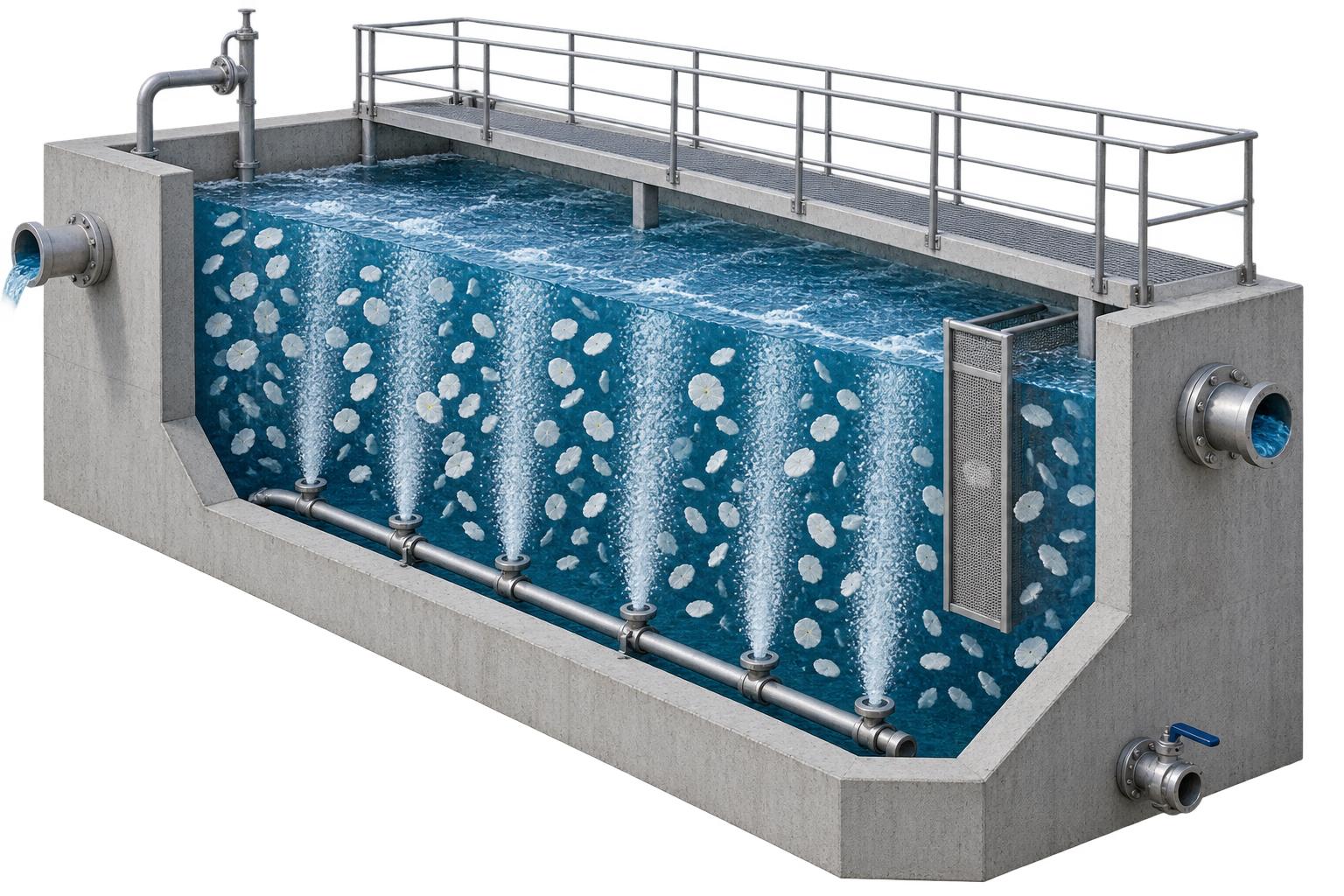
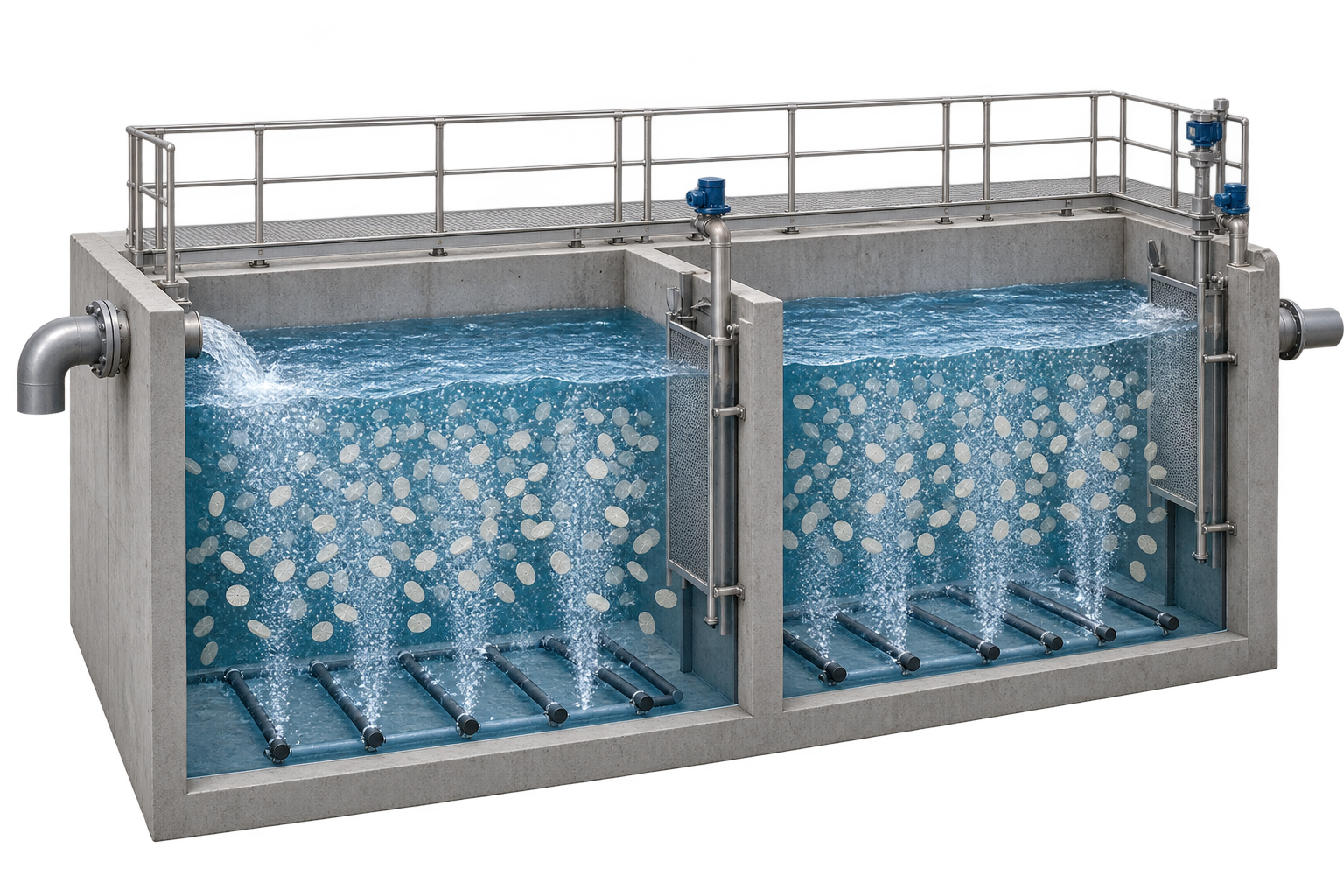
Concept view: concrete basin, aeration diffusers, suspended BioChip-style media and outlet-retention screens. Final tank geometry and selected media depend on the project.
Selection and design considerations
Species and peak feed rate
Feed composition and biomass
Water quality targets
TAN design load
Carrier quantity and reactor size
Water flow and aeration
Mixing and media retention
Monitoring and backup power
System at a glance
Design
TAN-led sizing
Biology
Selected cultures
Support
Operating SOPs
Configuration
Project-specific
Final capacities, materials, dimensions and operating limits are confirmed against the current model datasheet and project duty point.
01
Capacity planned around feed load, biomass and water quality goals.
02
Startup strategy matched to operating water conditions.
03
Clear checks, records and maintenance routines.
Complete brochure information
TAN-led design. Managed biofilter performance.
B01
Engineered for aquaculture
Product overview
TAN-led design. Managed biofilter performance.
Commercial concrete MBBR concept with aeration and media retention.
Capacity planned around feed load, biomass and water quality goals.
Startup strategy matched to operating water conditions.
Clear checks, records and maintenance routines.
Designed by Marine Blue Aquaculture Solutions
Illustrative product visual; final reactor and media are project-specific.
B02
Meet the process
Product description
A practical treatment stage for stable recirculating water.
Fish release ammonia continuously. A mature biofilter gives nitrifying microorganisms protected surfaces where they convert total ammonia nitrogen (TAN) to nitrite, then to nitrate. This treatment helps control dissolved nitrogen waste as water is reused. Nitrate still requires a separate management plan.
We begin with species, peak feed rate, feed composition, biomass and water quality targets. The TAN design load informs reactor size, carrier quantity, water flow, aeration, mixing and media-retention details. Final capacity is defined for the selected operating case rather than a generic tank volume.
Suitable nitrifying cultures or established media can support startup, but biofilm capacity must be proven through measured TAN and nitrite removal. Feed and biomass are increased gradually while dissolved oxygen, pH, alkalinity and temperature are tracked.
An operator SOP sets monitoring frequency, alert and action limits, records and corrective steps. Routine checks of air, flow, screens and media movement help protect performance as the farm's loading changes.
Build the biofilter around your production plan.
Share your species, peak daily feed, biomass, salinity and target water quality with Marine Blue.
B03
Our approach
TAN calculation + startup
A reliable result depends on biological capacity, hydraulic design and a startup procedure that operators can verify.
Estimate average and peak TAN load from the production plan; document assumptions and growth allowance.
Select reactor type, working volume, carrier media, flow path, aeration and media-retention screens.
Choose an inoculation approach suitable for salinity and temperature; raise the feed load progressively.
Trend TAN and nitrite with oxygen, pH, alkalinity, temperature and flow before increasing loading.
A culture should be suitable for the actual freshwater or saltwater conditions and intended temperature. A named inoculant is only one part of startup; measured TAN and nitrite trends confirm when the filter can accept more load.
Define who measures each parameter, the sampling location and frequency, alert limits, response actions and the record to keep. Include checks for blowers, pumps, screens, media movement and backup power.
The output is a biofilter that can be measured, maintained and expanded.
B04
Concrete MBBR, visualized
Commercial MBBR + operations
Concept view: concrete basin, aeration diffusers, suspended BioChip-style media and outlet-retention screens. Final tank geometry and selected media depend on the project.
Do
Don't
B05
Choose your configuration
Product details
Technology is selected for the water, load and operations team.
| Technology | Configuration |
|---|---|
| Moving bed (MBBR) | Aerated, moving carriers; well suited to modular or concrete RAS basins. |
| Fixed or submerged bed | Stationary media; solids control and planned cleaning protect flow paths. |
| Trickling filter | Water passes over air-exposed media; needs even distribution and access. |
| Fluidized bed | Upflow suspends fine media; operating flow must remain controlled. |
We compare TAN load, available space, solids capture, energy use, maintenance access and operating water conditions before selecting the process.
Provide species, peak daily feed, maximum biomass, salinity, temperature, water flow, target TAN and nitrite, available area and expansion plans.
Let's configure biological filtration for your system.
Marine Blue can define the TAN design basis, reactor arrangement, startup SOP and performance checks for your project.
Complete product information
Explore the full technical scope, applications, advantages and project considerations.
Modular biological filtration • conceptual equipment rendering. Media and reactor configurations designed to support nitrification and biological water treatment.
Start your project
Move from project concept to reliable commercial operation with one engineering partner.