
SPECIES PROFILE
Species profile
A globally cultured penaeid shrimp whose commercial performance depends on disciplined biosecurity, oxygen and solids control.
Also known as: Whiteleg shrimp; Pacific white shrimp; Vannamei; King prawn (market usage varies)
SPECIES PROFILE
Pictographic profile
- Water
- Brackish/marine
- Behaviour
- Benthic grazer
- Feeding
- Omnivorous
- Culture route
- Pond, Biofloc or indoor system
- Status
- Established with strict biosecurity
IDENTITY
Species overview
Pacific whiteleg shrimp is widely produced in coastal ponds, lined systems, Biofloc facilities and intensive indoor platforms. Its adaptability supports multiple production models, but high feeding and biomass loads can rapidly challenge oxygen, alkalinity, suspended-solids and nitrogen control.
IDENTITY
Biological features
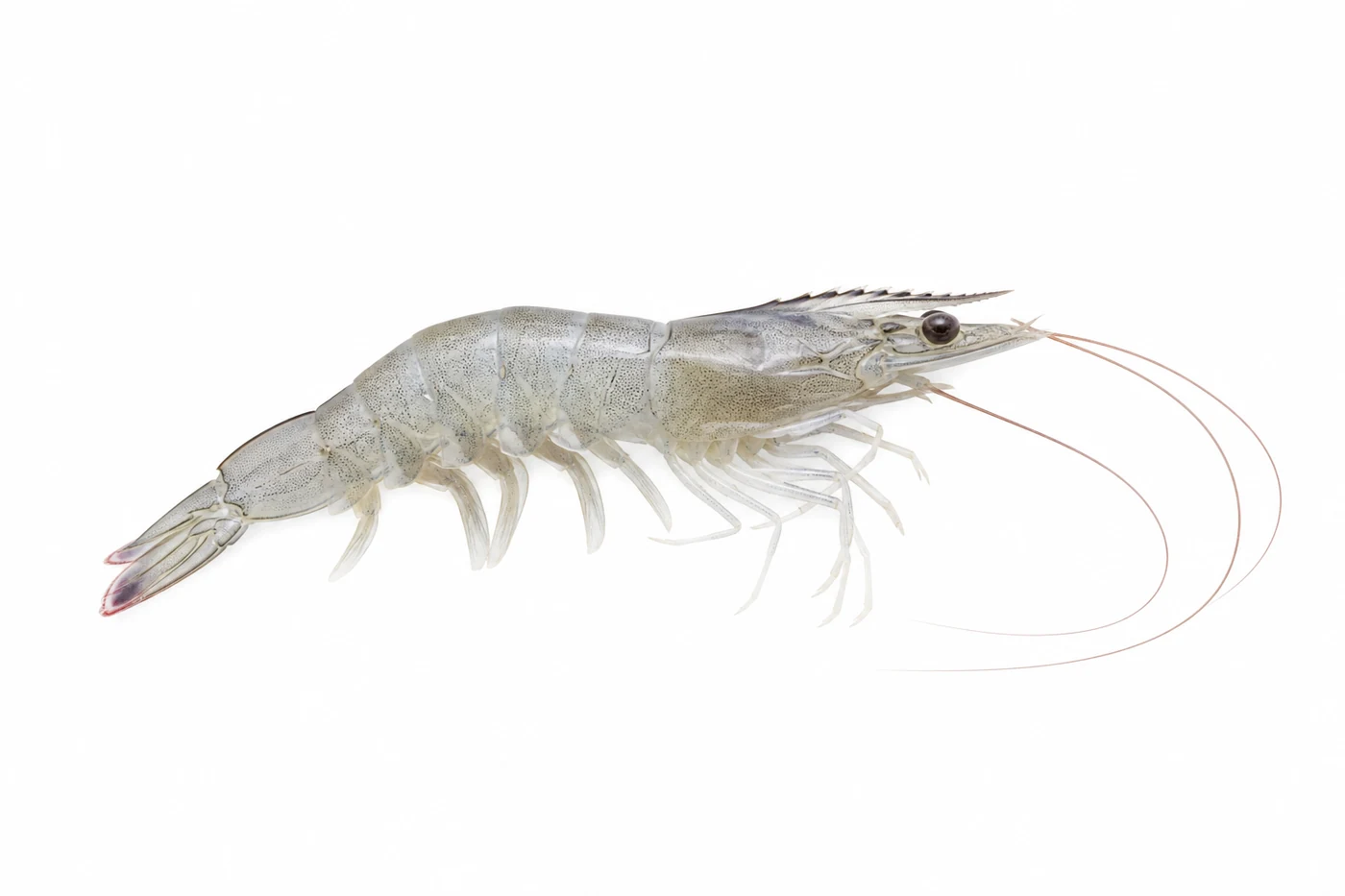
- Pale translucent body with white legs and a relatively uniform market appearance.
- Benthic and active across the pond or tank bottom, particularly during lower-light periods.
- Responsive to formulated feed and commonly managed through nursery and grow-out phases.
PROFILE
Historical background
Pacific whiteleg shrimp moved from its eastern Pacific native range into global aquaculture through hatchery development, selective breeding and formulated feeds. Its scale and adaptability created major production industries, while disease events demonstrated the cost of weak seed control and biosecurity.
PROFILE
Habits and behaviour
Juveniles naturally occupy estuarine nursery areas, while adults occur in marine coastal waters. They forage across the bottom, consume detrital material and small organisms, and respond strongly to feeding distribution and bottom condition.
PROFILE
Biology and life-cycle relevance
A penaeid shrimp with a multi-stage life cycle that moves from marine spawning through planktonic larval stages and estuarine juvenile development. Commercial production depends on health-screened seed, careful acclimation, moulting support and continuous observation of feeding and behaviour.
PROFILE
Suitable water ecosystem
Warm marine and brackishwater environments; lower-salinity culture is possible with appropriate ionic balance, acclimation and project-specific validation.
WATER AND NUTRITION
Indicative water-planning parameters
- Temperature
- 28-32 °C
- Salinity
- 5-35 ppt; ionic composition matters at low salinity
- pH
- 7.5-8.5; minimize daily swing
- Dissolved oxygen
- Target at or above 5 mg/L, including pre-dawn
- Additional control focus
- Track alkalinity, pH trend, dissolved oxygen, suspended solids, bottom condition, ammonia and nitrite; coordinate aeration, feeding and sludge removal.
Validate stage-specific targets, alarm limits and nitrogen thresholds through the approved system design.
WATER AND NUTRITION
Nutritional profile
- High-protein, low-fat seafood
- Provides vitamin B12, selenium, iodine, phosphorus and zinc
- Contains omega-3 fatty acids; exact values vary by feed, size and processing
Nutrition varies with feed, environment, season, harvest size, body portion and preparation. Use approved food-composition or laboratory data before publishing numeric per-100 g values.
PRODUCTION
Production cycle
Health-screened broodstock produce nauplii that pass through zoea, mysis and post-larval stages. Post-larvae may enter a nursery before acclimation and grow-out; the cycle ends with planned harvest, rapid chilling and movement into processing or fresh-market channels.
PRODUCTION
Production systems
- Lined or earthen ponds
- Biofloc tanks
- Indoor shrimp systems
- Nursery raceways and tanks
- Recirculating or hybrid water-treatment platforms
PRODUCTION
Seed supply
Use post-larvae from an authorized hatchery with clear batch identity, health documentation and acclimation history. Receiving checks should include behaviour, size uniformity, stress response and compatibility between transport and farm water.
PRODUCTION
Nursery
A controlled nursery can strengthen observation, feed transition, acclimation and inventory before grow-out. Oxygen, alkalinity, suspended solids, microbial stability and transfer density must be managed as feed input increases.
PRODUCTION
Ongrowing techniques
Earthen ponds, lined ponds, Biofloc tanks and indoor systems can be considered. Each model needs a defined water strategy, aeration and circulation plan, bottom or sludge management, feeding controls and crop-transition protocol.
PRODUCTION
Feed supply
Use complete shrimp feeds matched to size and system. Storage, feeding distribution, tray or sensor observations and adjustment against biomass and water quality are as important as the nominal ration.
PRODUCTION
Diseases and control measures
Viral, bacterial and microsporidian threats can cause major loss. Prevention relies on screened seed, exclusion barriers, water and carrier controls, surveillance, disciplined crop breaks and qualified diagnosis rather than unsupported medication claims.
PRODUCTION
Harvesting techniques
Partial or complete harvest should be planned around biomass, shell condition, buyer specification and weather. Clean water, rapid recovery, hygienic handling and immediate chilling protect the product.
PRODUCTION
Handling and processing
Shrimp are commonly washed, graded, chilled, frozen and processed into multiple product forms. Traceable lots, temperature control, potable-process water and approved food-safety systems belong to the processor's validated programme.
PRODUCTION
Market and trade
Vannamei serves large domestic and export markets in whole, head-on, peeled and value-added forms. Size count, residue compliance, traceability, certification and buyer specification influence the production and harvest plan.
STATUS AND TRENDS
Status and trends
Production is moving toward stronger seed traceability, lower water-exchange strategies, better energy management, automated observation and improved sludge handling. Intensification increases the importance of redundancy and operator competence.
MAIN ISSUES
Main issues
- Pathogen exclusion and batch traceability
- Oxygen failure at high feed and biomass
- Low-salinity ionic balance
- Suspended-solids and sludge control
- Antimicrobial stewardship and market compliance
SYSTEM DESIGN
System-design implications
- Biosecurity should shape intake, people, equipment and crop-transition workflows.
- Aeration must support oxygen transfer, circulation and solids movement without creating dead zones.
- Nursery and acclimation should protect seed quality before grow-out.
- Feed observation and sludge management need practical access and clear operating routines.
PROJECT DEFINITION
Move from species interest to project definition
A suitable system depends on exact stock, life stage, target biomass, source water, utilities, site, operating capability, regulation and market plan.
Internal links: Species directory; Relevant service; Products & Equipment; Knowledge Center; Contact
Plan a Vannamei Shrimp Facility