
SPECIES PROFILE
Species profile
A large-bodied premium shrimp that rewards stable pond ecology, careful seed selection and low-stress management.
Also known as: Black tiger shrimp; Giant tiger prawn; Tiger prawn; Asian tiger shrimp
SPECIES PROFILE
Pictographic profile
- Water
- Brackish/marine
- Behaviour
- Bottom-active
- Feeding
- Omnivorous predator
- Culture route
- Pond-led culture
- Status
- Premium large-size pathway
IDENTITY
Species overview
Giant tiger prawn remains important to premium shrimp markets because of its size, visual identity and product positioning. Production planning should recognize that its seed, stocking, feeding, health and water-management strategy is not interchangeable with Vannamei.
IDENTITY
Biological features
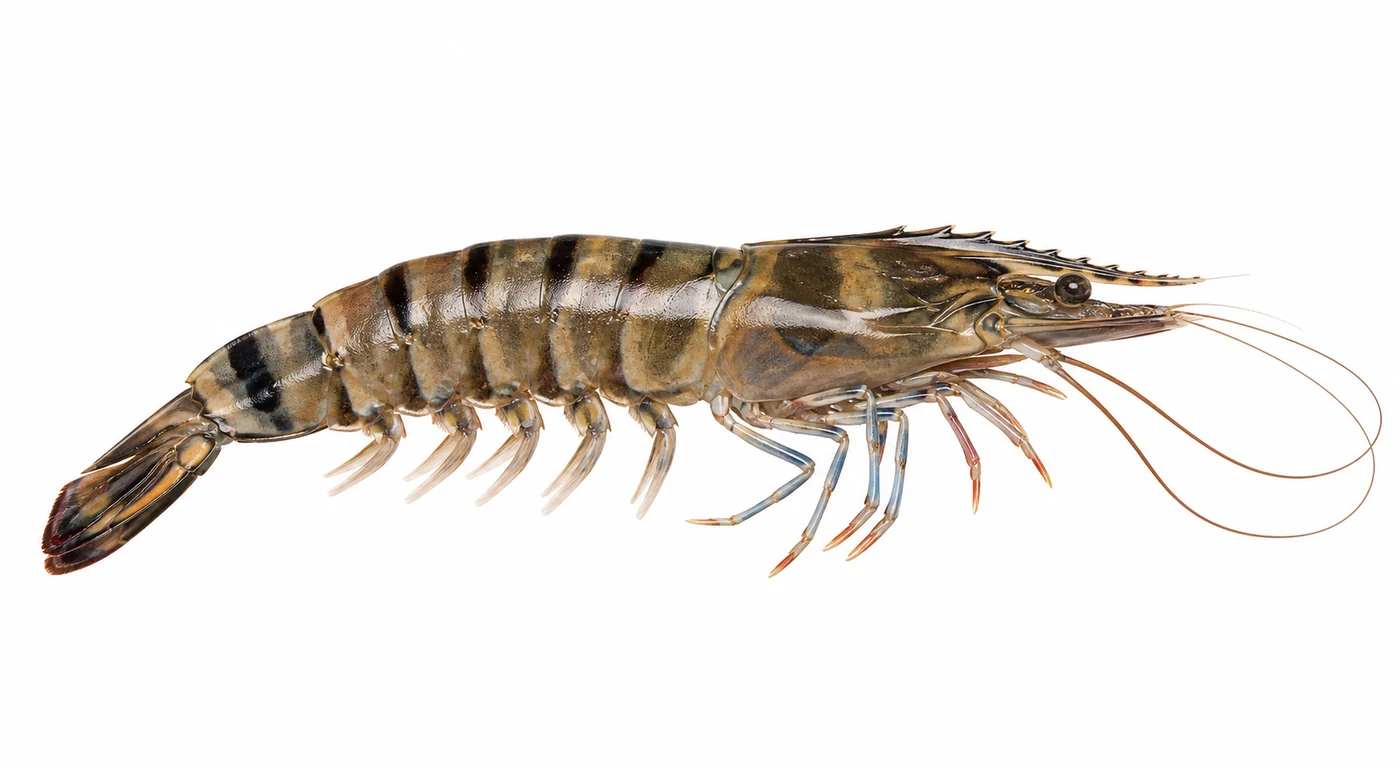
- Large penaeid shrimp with distinctive dark transverse bands across the shell and abdomen.
- Benthic, nocturnally active and strongly influenced by pond-bottom condition.
- Commercially valued for large harvest sizes and premium market presentation.
PROFILE
Historical background
Tiger shrimp farming developed from coastal pond traditions into hatchery-supported aquaculture across Asia. Disease, broodstock dependence and changing economics reduced its share in some regions, yet its large harvest size and premium identity continue to support renewed interest.
PROFILE
Habits and behaviour
Adults occur in marine waters and spawn offshore; post-larvae move into estuaries, mangroves and coastal nurseries. During culture, the shrimp use the pond bottom, feed on natural organisms and formulated diets, and require a stable environment during repeated moulting.
PROFILE
Biology and life-cycle relevance
The life cycle includes marine eggs and larvae followed by estuarine juvenile stages. Growth occurs through moulting, making mineral balance, water stability and access to suitable feed important. Health-screened broodstock and post-larvae are critical biological inputs.
PROFILE
Suitable water ecosystem
Warm tropical marine and brackishwater systems, particularly coastal ponds with suitable bottom management and water exchange or treatment strategy.
WATER AND NUTRITION
Indicative water-planning parameters
- Temperature
- 28-32 °C
- Salinity
- 10-30 ppt as a practical grow-out band; local strains and stages vary
- pH
- 7.5-8.5; avoid abrupt fluctuation
- Dissolved oxygen
- Target at or above 5 mg/L
- Additional control focus
- Maintain bottom quality, alkalinity, oxygen, pH stability and low toxic nitrogen; coordinate feeding with natural productivity and health surveillance.
Validate stage-specific targets, alarm limits and nitrogen thresholds through the approved system design.
WATER AND NUTRITION
Nutritional profile
- High-quality protein with low total fat
- Provides vitamin B12, selenium, phosphorus, iodine and zinc
- Contains marine omega-3 fatty acids, with composition influenced by diet and environment
Nutrition varies with feed, environment, season, harvest size, body portion and preparation. Use approved food-composition or laboratory data before publishing numeric per-100 g values.
PRODUCTION
Production cycle
Marine maturation and spawning are followed by larval rearing and post-larval acclimation. A nursery may precede lower-density pond grow-out, with harvest timing shaped by size, shell condition and premium-market requirements.
PRODUCTION
Production systems
- Earthen or lined brackishwater ponds
- Nursery tanks
- Lower-density indoor or recirculating concepts subject to validation
- Hatchery and maturation support systems
PRODUCTION
Seed supply
Seed identity, broodstock origin, health screening and hatchery biosecurity require verification. Receiving teams should evaluate post-larval quality and acclimate gradually to farm temperature, salinity and ionic conditions.
PRODUCTION
Nursery
Nursery systems improve early observation and stock accounting but must protect moulting shrimp from crowding and unstable water. Feed transition, bottom cleanliness and transfer readiness deserve explicit protocols.
PRODUCTION
Ongrowing techniques
Production is commonly pond based, with stocking and feeding aligned to aeration, water quality and bottom capacity. More controlled tank or recirculating concepts require species-specific trials rather than assumptions drawn from Vannamei.
PRODUCTION
Feed supply
Use complete feeds matched to stage, with careful distribution across the benthic feeding area. Natural pond productivity may contribute, but it does not replace ration control, storage hygiene or feed-response records.
PRODUCTION
Diseases and control measures
Health threats overlap with other penaeid shrimp but the epidemiology and management plan must be stock and site specific. Screened seed, carrier control, water treatment, surveillance and professional diagnosis are primary controls.
PRODUCTION
Harvesting techniques
Harvest should preserve shell quality and large-size presentation. Plan water level, nets or drainage, washing, grading and ice so that the product moves quickly without contamination or excessive physical damage.
PRODUCTION
Handling and processing
Premium product may be sold head-on or whole, making colour, appendage condition and rapid chilling important. Processor controls should address hygiene, lot identity, temperature and buyer-specific forms.
PRODUCTION
Market and trade
Black tiger shrimp is often positioned around larger counts, whole-product appearance and premium channels. Real price advantage depends on grade, season, quality, buyer and production cost and should not be promised in website copy.
STATUS AND TRENDS
Status and trends
Interest is supported by selective breeding, improved health screening and premium-market differentiation. Expansion depends on reliable seed and a production strategy designed for the species rather than copied from Vannamei.
MAIN ISSUES
Main issues
- Reliable health-screened seed
- Pond-bottom quality and moulting stability
- Species-specific feeding and density decisions
- Large-size harvest consistency
- Disease surveillance and crop biosecurity
SYSTEM DESIGN
System-design implications
- Pond-bottom and sludge strategy deserve early engineering attention.
- Aeration layout should protect both oxygen and bottom movement.
- Seed, acclimation and health protocols must be species-specific.
- Harvest and cold-chain design should preserve large-size premium presentation.
PROJECT DEFINITION
Move from species interest to project definition
A suitable system depends on exact stock, life stage, target biomass, source water, utilities, site, operating capability, regulation and market plan.
Internal links: Species directory; Relevant service; Products & Equipment; Knowledge Center; Contact
Discuss a Tiger Shrimp Production Plan