
SPECIES PROFILE
Species profile
A territorial estuarine crustacean whose individual management can transform stocking, feeding and harvest control.
Also known as: Mud crab; Giant mud crab; Green mud crab; Mangrove crab
SPECIES PROFILE
Pictographic profile
- Water
- Estuarine
- Behaviour
- Territorial benthic animal
- Feeding
- Carnivore
- Culture route
- Vertical compartments or ponds
- Status
- Established fattening, nursery and holding
IDENTITY
Species overview
Giant mud crab is a high-value estuarine species used for nursery, fattening, conditioning, soft-shell production and live holding. Its aggression and cannibalistic behaviour make individual compartments especially relevant to vertical recirculating systems.
IDENTITY
Biological features
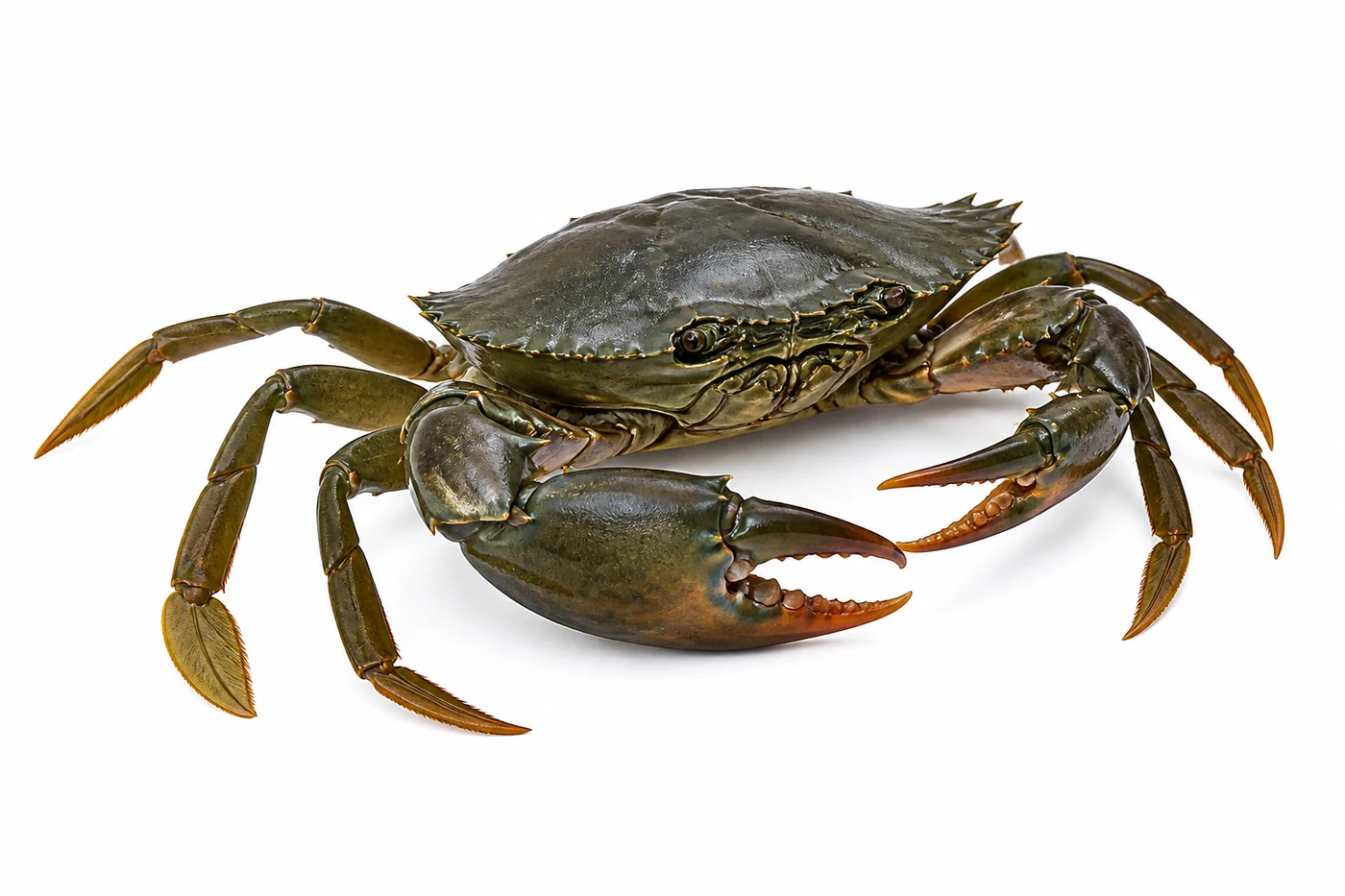
- Broad olive-green carapace, powerful claws and paddle-shaped rear legs.
- Strong, territorial and capable of climbing or escaping poorly secured culture units.
- Well suited to individual observation, feeding and harvest decisions.
PROFILE
Historical background
Mud crab fisheries and traditional fattening are closely connected to mangrove and estuarine communities. Hatchery and nursery advances are supporting more controlled production, while individual-compartment systems address aggression, observation and live-market handling.
PROFILE
Habits and behaviour
Mud crabs occupy mangrove creeks, estuaries, tidal flats and sheltered coastal waters. They are mainly benthic and opportunistic carnivores, feeding on molluscs, crustaceans, fish and organic material. Activity, feeding and shelter use change around moulting.
PROFILE
Biology and life-cycle relevance
Mud crabs grow by moulting and require protection while the new shell hardens. Females migrate toward higher-salinity water for spawning, and larvae are more marine than later juvenile stages. Growth stage, sex, moult condition and shell quality influence husbandry and market readiness.
PROFILE
Suitable water ecosystem
Warm estuarine and brackishwater environments with stable salinity, shelter or individual compartments, good oxygen and effective removal of feed residues.
WATER AND NUTRITION
Indicative water-planning parameters
- Temperature
- 28-30 °C for accelerated culture; broader tolerance is stage-dependent
- Salinity
- 15-30 ppt for grow-out; larvae commonly require higher, tightly controlled salinity
- pH
- 7.5-8.5
- Dissolved oxygen
- Target at or above 5 mg/L
- Additional control focus
- Control feed residues, ammonia, nitrite, alkalinity and salinity; provide secure compartments, safe moult conditions and reliable flow to every unit.
Validate stage-specific targets, alarm limits and nitrogen thresholds through the approved system design.
WATER AND NUTRITION
Nutritional profile
- High-quality, lean protein
- Provides vitamin B12, selenium, zinc, copper and phosphorus
- Contains marine omega-3 fatty acids; edible yield and composition vary by size, sex and moult stage
Nutrition varies with feed, environment, season, harvest size, body portion and preparation. Use approved food-composition or laboratory data before publishing numeric per-100 g values.
PRODUCTION
Production cycle
Marine larval stages develop through zoea and megalopa before settling as crablets. Nursery, grow-out or fattening may follow; soft-shell production adds repeated moult observation, while live-holding focuses on short-term condition and dispatch.
PRODUCTION
Production systems
- Vertical individual-compartment RAS
- Fattening and conditioning units
- Nursery and quarantine
- Soft-shell crab systems
- Live holding and market preparation
PRODUCTION
Seed supply
Confirm species, source, health, size, limb condition and legal status. Hatchery crablets support traceability, while wild collection may carry ecological, seasonal and health concerns that require local review.
PRODUCTION
Nursery
Shelter, size grading and feeding access help limit cannibalism. Individual cells or carefully structured communal units should allow inspection, secure containment and rapid removal of feed waste.
PRODUCTION
Ongrowing techniques
Ponds, pens and individual-compartment RAS serve different objectives. Vertical systems trade shared floor area for individual control and therefore depend on reliable flow distribution, drainage, rack access and labour-efficient feeding.
PRODUCTION
Feed supply
Feeds may include approved fresh materials or formulated diets depending on the production model. Storage hygiene, ration control and prompt residue removal are critical because decomposing feed rapidly loads the water system.
PRODUCTION
Diseases and control measures
Biosecurity should cover seed, water, feed, tools and mortalities. Shell, gill and systemic conditions require observation and diagnosis; moulting animals are particularly vulnerable to stress and poor water.
PRODUCTION
Harvesting techniques
Harvest decisions consider body weight, shell hardness, moult stage, limb condition and buyer specification. Secure, low-stress handling and trained claw restraint protect workers and animals.
PRODUCTION
Handling and processing
Live quality depends on gentle handling, cool stable conditions, moisture management and short, planned logistics. Processed product requires hygienic cooking or chilling and validated food-safety controls.
PRODUCTION
Market and trade
Markets may value live hard-shell crab, fattened crab, soft-shell crab or processed meat. The chosen product defines grading, infrastructure, labour and dispatch requirements.
STATUS AND TRENDS
Status and trends
Vertical and individual culture is attracting interest because it can improve observation and stock separation. Commercial success remains closely linked to seed continuity, labour design, feed hygiene and live-market logistics.
MAIN ISSUES
Main issues
- Cannibalism and escape
- Reliable crablet supply
- Feed-residue and sludge control
- Moult-stage monitoring and labour demand
- Live logistics and welfare
SYSTEM DESIGN
System-design implications
- Individual compartments reduce direct aggression and simplify observation.
- Supply and return headers must distribute water consistently across vertical racks.
- Feeding, waste removal, moult checks and mortality handling should be operator-friendly.
- Live-holding and dispatch plans must protect welfare and market quality.
PROJECT DEFINITION
Move from species interest to project definition
A suitable system depends on exact stock, life stage, target biomass, source water, utilities, site, operating capability, regulation and market plan.
Internal links: Species directory; Relevant service; Products & Equipment; Knowledge Center; Contact
Discuss a Vertical Mud Crab System