
SPECIES PROFILE
Species profile
A fast-moving coastal pompano for marine cages, brackishwater ponds and controlled tank systems -distinct from true pomfret.
Also known as: Golden pompano; Snubnose pompano; Silver pompano; Yellowfin pompano (trade usage varies); sometimes marketed loosely as pomfret, but not a true pomfret
SPECIES PROFILE
Pictographic profile
- Water
- Marine/brackish
- Behaviour
- Active schooler
- Feeding
- Carnivore
- Culture route
- Cage, pond or RAS
- Status
- Established aquaculture candidate
IDENTITY
Species overview
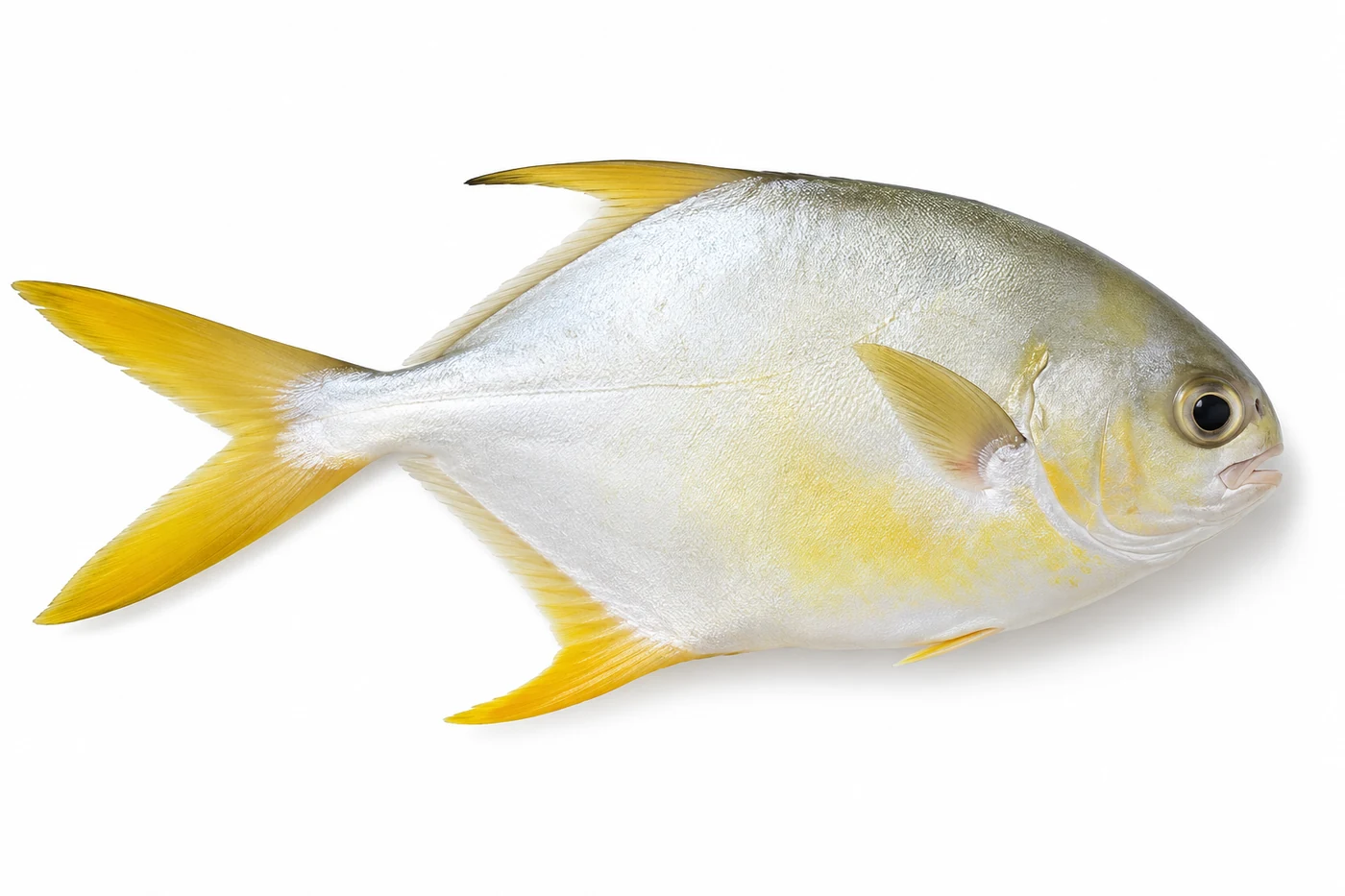
Here, 'yellow fin pomfret' refers to golden or snubnose pompano, Trachinotus blochii, an established aquaculture candidate in India. It belongs to the jack family and is not a true pomfret. Confirm the intended market name and species identity for each project.
IDENTITY
Biological features
- Deep, laterally compressed silver body with a blunt snout and deeply forked tail.
- Active schooling fish that requires unobstructed swimming space and suitable current distribution.
- Recognized for firm flesh, market value and suitability for whole-fish presentation.
PROFILE
Historical background
Golden or snubnose pompano has developed as a cultured carangid in Asia and has been demonstrated in Indian marine and brackishwater systems. It is sometimes sold under loose 'pomfret' wording, but biologically it is a pompano and not a true Pampus pomfret.
PROFILE
Habits and behaviour
Silver pompano occupies tropical coastal waters, sandy shorelines and reef-associated habitats. It is an active feeder that consumes zooplankton, small crustaceans, molluscs and fish, and readily accepts formulated diets under culture.
PROFILE
Biology and life-cycle relevance
A marine carangid with pelagic eggs and larvae. Hatchery and nursery stages are sensitive to feed transition, stocking density, light, temperature and water quality. Juveniles can acclimate to brackishwater, but abrupt change should be avoided.
PROFILE
Suitable water ecosystem
Warm tropical marine and brackishwater environments with good oxygen, open swimming volume and stable salinity.
WATER AND NUTRITION
Indicative water-planning parameters
- Temperature
- 27-31 °C
- Salinity
- 10-35 ppt as a practical culture band; lower levels require staged acclimation and validation
- pH
- 7.5-8.5
- Dissolved oxygen
- Target at or above 5 mg/L
- Additional control focus
- Protect oxygen, swimming space, salinity stability and feed quality; manage solids, ammonia and nitrite; avoid sudden cold or salinity stress.
Validate stage-specific targets, alarm limits and nitrogen thresholds through the approved system design.
WATER AND NUTRITION
Nutritional profile
- High-quality protein
- Moderate lipid content with marine fatty acids
- Provides vitamin B12, selenium and phosphorus; exact profile varies by feed and harvest size
Nutrition varies with feed, environment, season, harvest size, body portion and preparation. Use approved food-composition or laboratory data before publishing numeric per-100 g values.
PRODUCTION
Production cycle
Marine broodstock and hatchery larvae progress through live feed, weaning and nursery before pond, cage or tank grow-out. Staged salinity acclimation may support brackishwater production, followed by harvest to whole-fish market grades.
PRODUCTION
Production systems
- Marine cages
- Brackishwater ponds
- Land-based flow-through or RAS tanks
- Hatchery and nursery
- Coastal integrated farming concepts
PRODUCTION
Seed supply
Obtain hatchery juveniles with confirmed Trachinotus blochii identity, health, salinity and size history. Seed availability and transport planning should be verified before the production calendar is committed.
PRODUCTION
Nursery
Active juveniles require open swimming space, stable oxygen and well-distributed feed. Nursery design should facilitate grading and gradual salinity transitions without sharp corners or excessive crowding.
PRODUCTION
Ongrowing techniques
Cages, coastal ponds and land-based tanks may be used. Flow, oxygen, solids and feeding should accommodate an active schooling fish; cage projects additionally require site, exposure, net and fouling assessment.
PRODUCTION
Feed supply
Complete marine finfish feeds are used, with pellet size and delivery matched to schooling behaviour. Feed storage and ration adjustment should protect lipid quality and limit uneaten feed.
PRODUCTION
Diseases and control measures
Good seed, quarantine, stable salinity and oxygen, net hygiene and diagnostic support form the control base. Treatment should follow professional diagnosis and local regulation.
PRODUCTION
Harvesting techniques
Plan fasting, crowding, capture and rapid chilling to protect the bright skin, firm flesh and whole-fish appearance. Live holding is a separate design case.
PRODUCTION
Handling and processing
Whole chilled and processed forms require clean surfaces, temperature control and buyer-specific grading. The commercial name should be consistent across labels and website copy.
PRODUCTION
Market and trade
Golden pompano has growing premium-market recognition. Projects should validate whether buyers use 'golden pompano', 'silver pompano' or another local name and avoid implying it is true pomfret.
STATUS AND TRENDS
Status and trends
The species remains a relevant diversification candidate for Indian marine and brackishwater aquaculture, with interest in cages, ponds and controlled systems.
MAIN ISSUES
Main issues
- Common-name confusion with true pomfret
- Hatchery seed continuity
- Active-swimmer tank and cage design
- Salinity acclimation
- Premium skin and whole-fish handling
SYSTEM DESIGN
System-design implications
- Tank and cage geometry should support sustained swimming and even feed access.
- Brackishwater projects require ionic and salinity planning, not salinity alone.
- Hatchery and nursery demand more precise feed and environmental control.
- Confirm the commercial species name before branding, SEO or image approval.
PROJECT DEFINITION
Move from species interest to project definition
A suitable system depends on exact stock, life stage, target biomass, source water, utilities, site, operating capability, regulation and market plan.
Internal links: Species directory; Relevant service; Products & Equipment; Knowledge Center; Contact
Discuss a Silver Pompano Project