
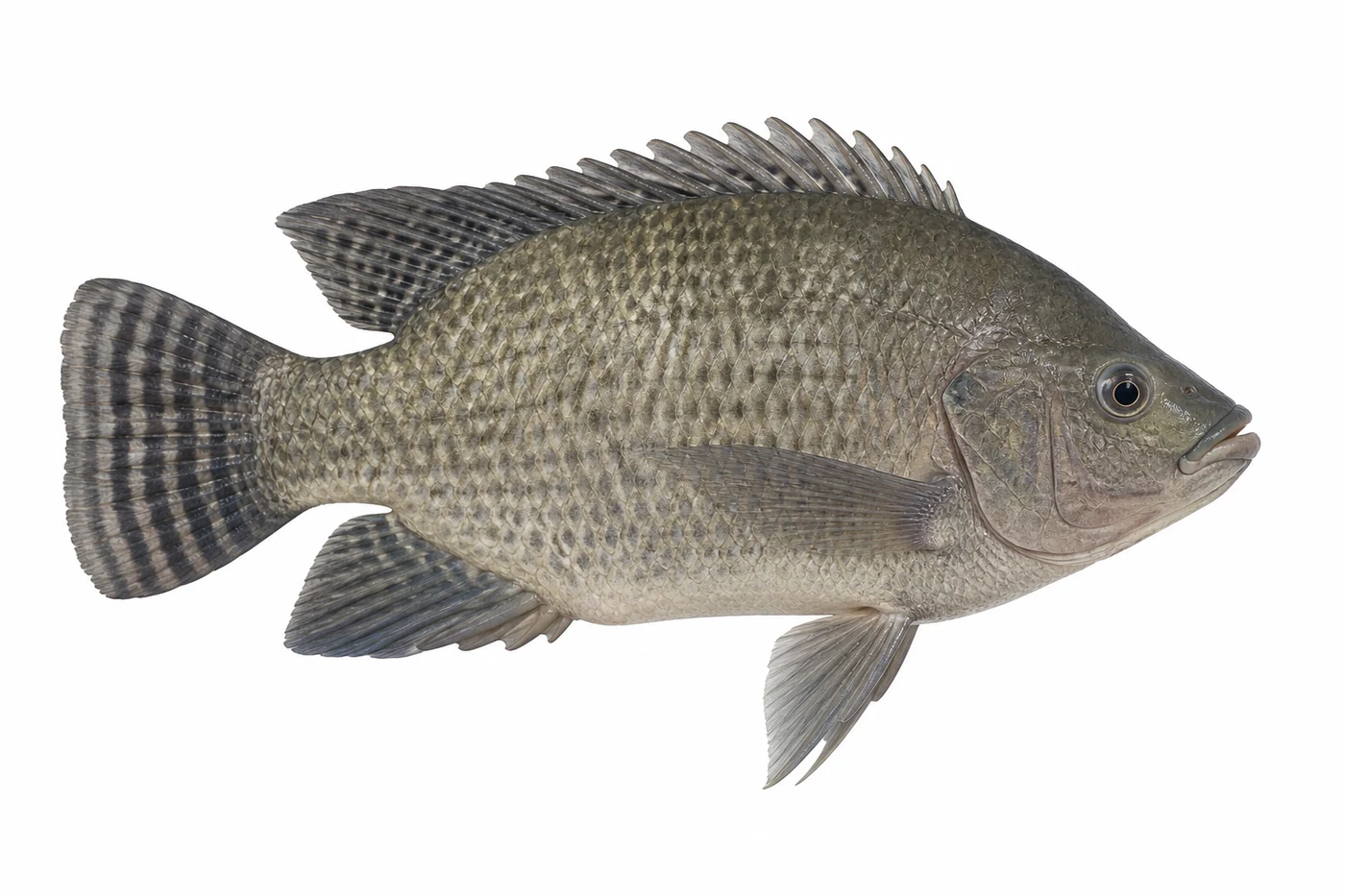
SPECIES PROFILE
Species profile
A versatile warm-water species for ponds, cages, Biofloc, RAS and integrated production.
Also known as: Nile tilapia; Tilapia; Nilotica; Nile mouthbrooder
SPECIES PROFILE
Pictographic profile
- Water
- Warm freshwater
- Behaviour
- Social grazer
- Feeding
- Omnivore
- Culture route
- Pond, cage, Biofloc, RAS or Aquaponics
- Status
- Established global culture
IDENTITY
Species overview
Nile tilapia is one of aquaculture's most adaptable commercial finfish. It accepts varied production systems and formulated diets, yet commercial consistency still depends on seed quality, sex strategy, temperature, oxygen, solids management, feeding and harvest planning.
IDENTITY
Biological features
- Deep laterally compressed body with a continuous dorsal fin and dark bars on the tail.
- Omnivorous grazer capable of using plankton, periphyton, detritus and formulated feeds.
- Hardy, widely accepted and suitable for multiple fresh-market and fillet forms.
PROFILE
Historical background
Nile tilapia moved from traditional African fisheries and pond culture into one of the world's most important farmed finfish industries. Hatchery sex management, improved strains, feeds and varied production systems support its scale.
PROFILE
Habits and behaviour
Nile tilapia prefers warm, shallow freshwater and spends much of its time grazing surfaces and suspended food. Social hierarchy and territorial nesting occur during breeding, while cage culture disrupts successful recruitment.
PROFILE
Biology and life-cycle relevance
A maternal mouth brooder that can reproduce frequently in warm conditions. Commercial farms commonly use controlled-sex populations to limit unwanted recruitment, stunting and harvest-size variation.
PROFILE
Suitable water ecosystem
Warm freshwater ponds, lakes, reservoirs and controlled tanks; limited brackishwater use is possible with suitable stock and acclimation.
WATER AND NUTRITION
Indicative water-planning parameters
- Temperature
- 27-32 °C for commercial growth
- Salinity
- Freshwater; up to about 10 ppt may suit selected stocks with acclimation
- pH
- 6.5-8.5
- Dissolved oxygen
- Target at or above 5 mg/L
- Additional control focus
- Manage seed and sex strategy, temperature, oxygen, suspended solids, ammonia, nitrite, alkalinity, off-flavour and unintended reproduction.
Validate stage-specific targets, alarm limits and nitrogen thresholds through the approved system design.
WATER AND NUTRITION
Nutritional profile
- High-quality lean protein
- Low to moderate fat
- Provides vitamin B12, selenium and phosphorus; fatty-acid profile depends strongly on feed
Nutrition varies with feed, environment, season, harvest size, body portion and preparation. Use approved food-composition or laboratory data before publishing numeric per-100 g values.
PRODUCTION
Production cycle
Broodstock produce mouth-brooded fry, followed by sex management where lawful, nursery and pond, cage, Biofloc, RAS or Aquaponics grow-out. Harvest scheduling targets a defined whole-fish or fillet size.
PRODUCTION
Production systems
- Earthen or lined ponds
- Floating cages
- Biofloc tanks
- Warm-water RAS
- Aquaponics
- Hatchery and nursery
PRODUCTION
Seed supply
Use authorized hatchery seed with documented strain, health and sex strategy. Avoid assuming that every tilapia strain has the same growth, salinity, cold tolerance or market fit.
PRODUCTION
Nursery
Nursery systems support feed training, grading and controlled populations. Temperature, oxygen and ammonia must remain stable as fry grow rapidly.
PRODUCTION
Ongrowing techniques
The species adapts to many systems, but each requires a defined solids, oxygen and water strategy. Aquaponics additionally needs alignment between feed input and plant nutrient demand.
PRODUCTION
Feed supply
Complete feeds formulated by life stage are standard. Accurate biomass, storage, delivery and feed-response observation protect cost and water quality.
PRODUCTION
Diseases and control measures
Streptococcal disease, tilapia lake virus and other risks require healthy seed, temperature and oxygen control, surveillance, sanitation and professional advice.
PRODUCTION
Harvesting techniques
Fasting, gentle crowding and rapid chilling support quality. Off-flavour assessment may be needed in ponds or recirculating systems before harvest.
PRODUCTION
Handling and processing
Tilapia is sold live, whole, gutted or filleted. Clean depuration where justified, ice, processing hygiene and traceable labelling support market access.
PRODUCTION
Market and trade
Tilapia serves affordable mass markets and premium live or fresh niches. Product size, colour, fillet yield, freshness and buyer expectations shape economics.
STATUS AND TRENDS
Status and trends
Improved genetics, vaccines, feeds, Biofloc, RAS and digital monitoring continue to develop. Responsible growth depends on biosecurity, effluent management and control of non-native escape.
MAIN ISSUES
Main issues
- Seed and strain quality
- Unwanted reproduction and stunting
- Warm-water energy outside suitable climates
- Disease and biosecurity
- Off-flavour, waste and market differentiation
SYSTEM DESIGN
System-design implications
- Heating and insulation may determine feasibility outside warm climates.
- Circular tanks and drains should support continuous solids removal.
- Biofloc or RAS designs must follow real feed load and oxygen demand.
- Aquaponics requires balancing fish feeding with plant nutrient demand.
PROJECT DEFINITION
Move from species interest to project definition
A suitable system depends on exact stock, life stage, target biomass, source water, utilities, site, operating capability, regulation and market plan.
Internal links: Species directory; Relevant service; Products & Equipment; Knowledge Center; Contact
Explore a Tilapia Production System